How we work
Measure, act, measure again.
Before anything changes, we put ears on the ground and leave them there, same spots, same hours, week after week, until there's an honest record of what your land supports right now. That's the baseline, and it's the one part that can't be done later. Once the fence goes up, the before is gone.
Then you make your move: the grazing change, the hedgerow, the owl boxes, the creek planting. Your plan, your crew, your adviser. We don't design it and we don't sell it to you. We just write down the date it happened.
Then we come back in the same season, to the same stations, for the same hours, and tell you what changed, including the times the answer is not yet.
A good year lifts everything. The point is knowing which part of the change was yours.
This hands-on loop is where we're starting. It's the whole service in 2026. Where we're headed is simpler for you: Ears that just keep listening and reporting, year-round, without a visit scheduled to make them useful. These field studies are how we get there honestly, one property at a time.
What the land tells you
Who's out there, where, and when.
Most land holds more wildlife than anyone gets to hear. It just sings when nobody's standing there to hear it. Four in the morning, the far corner, the week you were somewhere else. Still Habitat listens around the clock and writes it down: every species named, every detection timestamped, and how sure the Ear was each time.
Nothing to install, nothing to learn, and no one has to be on site. The land keeps its own record; we just make it readable.
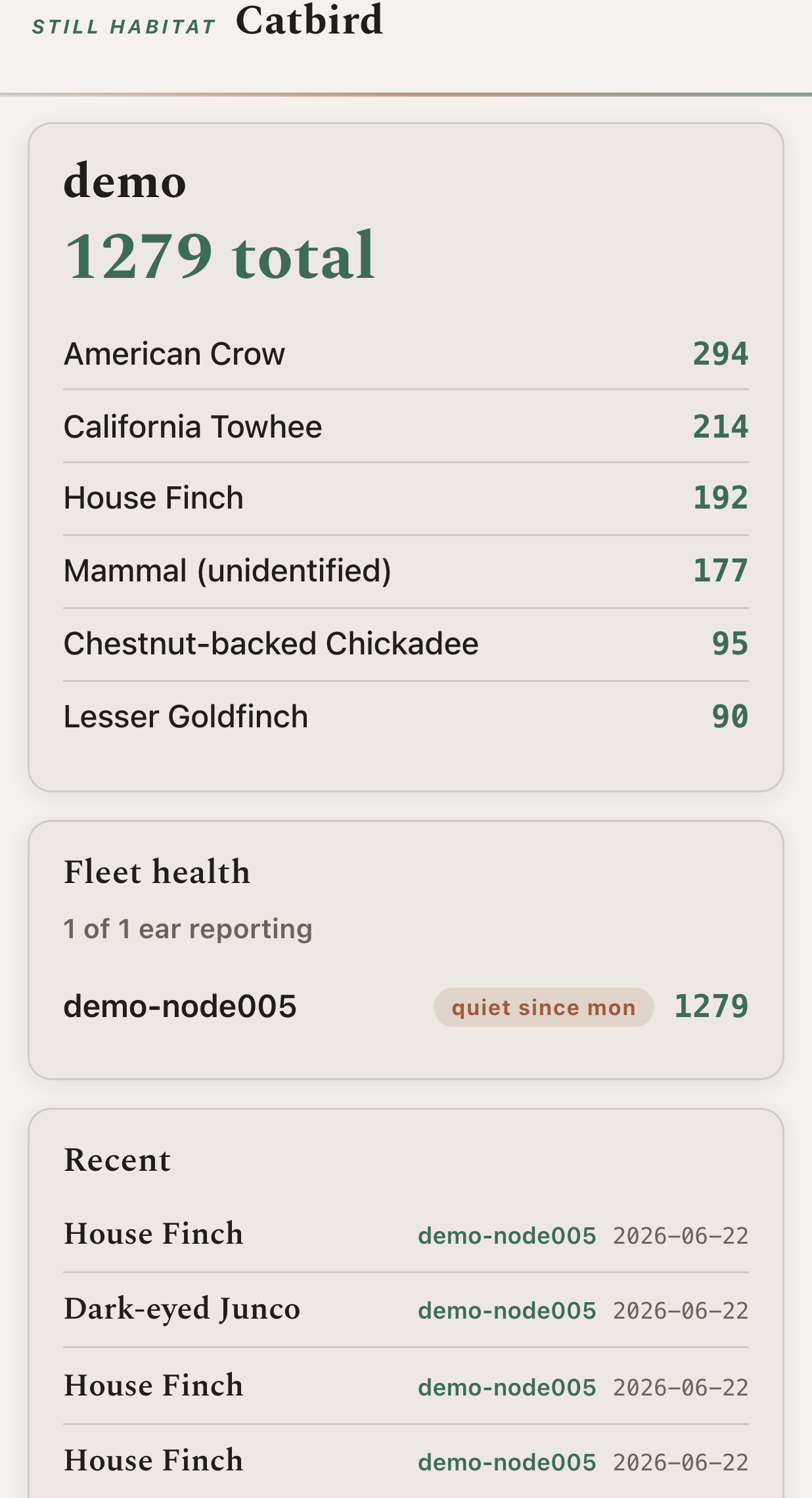
A mock of the live view, using an imagined property and invented Ear names.
How it works
We handle the listening. You get the record.
There's nothing for your crew to run. The Ears listen on their own; the study itself we do together, about half a day walking the property, and half a day again next season. We place the Ears, tune them to your land, and hand you a record you own outright. Live while it's happening, and in your own files when you want to work with it.
We place the Ears
Small, solar-powered, weatherproof Ears go wherever your wildlife is: the meadow, the creek, the vineyard rows. No wiring, no Wi-Fi to run. Maintenance is ours; if something goes down, we come out.
Every sound gets its name
Each Ear names what it hears on the spot, tuned to the species likely at your coordinates. Identification is built on Perch, Google's open-source bird-audio model (Apache-2.0), so it runs entirely on the device and the audio never leaves your land. Reports show likely and high model-confidence matches. These are automated suggestions, not human-verified records. Possible matches are retained but excluded from reports.
You watch it as it happens
Detections appear the moment they land, on your phone from anywhere or on a screen for whoever's standing there. Check the far paddock at dawn without driving to it.
You get the whole record to keep
At any point you can pull a complete review of your property: a polished PDF to hand around, a raw CSV of every detection to dig into, and GIS layers that drop straight into the mapping and land-management tools you already use. It's your data, in the formats your other tools speak.
Out in the meadow, the vineyard rows, or along the creek, a small solar panel runs an Ear through most of the year. No trenching, no outlet, no battery swaps. A long grey stretch can still run one down, and catching that is on us, not you.
Near a barn, a porch, or the tasting room, just plug an Ear into any USB-C charger. Useful where solar won't reach: deep shade, dense canopy, a north wall. Same device, same data, either way.
What it's for
Questions the land can answer, if something is listening.
Did the hedgerow get used? Did anything come back to the creek after the work? Is the far paddock quieter than the near one, and was it always? Did this spring arrive richer than last spring, or does it just feel that way? These are answerable questions. They only need somebody standing in the right place at four in the morning, every day, for a year. That's the part we do.
The same record answers the other kind of question too. When people are on the land, whether that's guests, members, a buyer or your own crew, the hawk at noon and the owl at midnight are right there on a screen. You don't have to choose which job it's doing. It's one record.
Catbird · the live view
Your whole property, live in your hand.
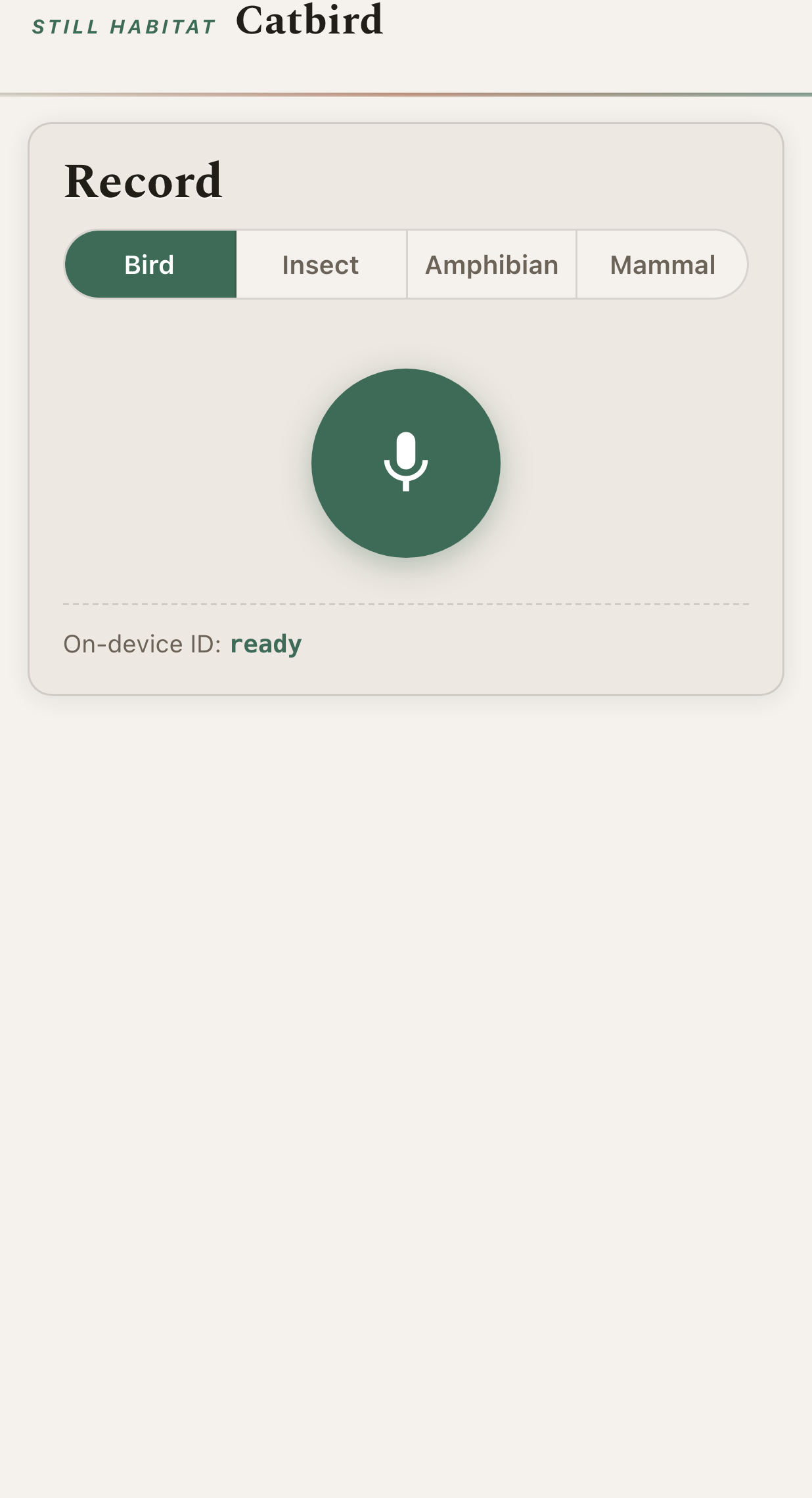
Catbird is the live view of your land, with Place, Map, Log, and Record all in one screen. It runs in any browser, with no app store and no download. Check the far side of the property from the truck, or share a link or QR code and anyone you hand it to has it on their own phone in a tap.
Whole-property coverage
Big properties need more than one place to listen.
One Ear hears a few hundred feet. A mesh gets those Ears talking to each other, so you can put one at the creek and one on the ridge and get both, even where there's no power and no signal nearby. It's the reach for the data, not for the hearing; coverage still comes down to where we put them. And the part of a property most worth listening to is usually the part farthest from an outlet.
Every Ear passes what it hears down the chain to a single gateway, parked just outside the property where there's power and a signal. That one point is all that ever touches the internet. So you can check the creek and the back fence in one feed, no matter how far apart they sit on the land.
Beyond the season
A year of listening becomes evidence.
The live view is for today. A year is a different thing. Year one is the benchmark, meaning what the land supported before you touched it. Then you change something: the creek planting, the rotation, the hedgerow. Year two is measured the same way, by the same Ears, at the same hours. Where it matters we also leave an area you didn't treat listening alongside it, because a good year lifts everything, and you want to know which part of the change was yours.
What a year tells you
Worked examples for an imagined property. Every number below is invented to show the shape of a finding. Yours would come from your own detections, and would only ever say what your land was actually heard to support.
What actually lands in your hands
- A species list with counts and trends across the year
- Every detection with its confidence tier attached, so you can weigh each line rather than take the list on faith
- A verifiable biodiversity baseline for certifiers and funders
- Uptime alongside the ecology, so a quiet week and a dead microphone can be told apart
- A live species tally you can embed on your own site
- A polished PDF review, the raw CSV, and GIS layers for your own tools
Birds are our proven signal today, and our other taxa are catching up fast. We've already had real success naming insects and mammals in the field, and the 2026 studies are how we take that from promising to proven. Reports show likely and high model-confidence matches. These are automated suggestions, not human-verified records. Possible matches are retained but excluded from reports.
Who it's for
Land that's being managed for something.
If you're changing how a place is grazed, planted, watered or left alone, the wildlife is the readout, and it's the readout that's hardest to hold onto between seasons.
Whether the grazing plan, the hedgerows, or the riparian work is actually building habitat. Measured the same way across seasons and paddocks, so this year is comparable to last.
What came back, when, and how it compares to ground you left alone. The hard part of proving the work worked, running on its own.
You design and build the habitat. We're the instrument that shows a client whether it took. Your name stays on the work.
Evidence of the living system behind the label, in a form a certifier, a buyer, or a funder will actually accept.
Owl boxes, kestrel perches, insectary strips and hedgerows go in on faith and get checked by eye. Whether they're actually being used, and staying used, is something we can measure season after season.
We don't design or plant anything. No planting plans, no earthworks, no advice on how to run your land. If you already work with a designer, a contractor or a grazing adviser, the plan stays theirs. We measure what's there before the work and what changed after, which is worth more coming from someone with nothing riding on the answer.
You're in control
You decide what the world sees.
Show your wildlife off if you want to. Most properties want their biodiversity seen. But it's your call: the public view shows the species and the story, while the complete record, the exact spots, and the raw recordings stay with you in Catbird, to share or keep as you like. Nothing about your land goes public unless you put it there.
You keep every insight. You choose what to share.
About
Still Habitat is a Bay Area company building acoustic wildlife monitoring for private land: the hardware and the dashboard are ours end to end. Identification runs on Perch, Google's open-source bird-audio model, which we train and tune on our own regional data and configuration for the species and places we work in. Questions or partnerships, write us at [email protected]
What you get
Everything included. Nothing to figure out.
We're running a small pilot on Bay Area properties this summer. Pilot installs are free, in exchange for real-world feedback that shapes the product. Here's exactly what that means.
Full install, no cost
-
Hardware: Ears placed on your landThree to six weatherproof listening Ears, positioned by us across the areas that matter most: meadow, creek, vineyard, orchard, plus a matched piece of ground you're leaving alone. Solar-powered or USB-C, wherever makes sense.
-
On-device AI, tuned to your regionEach Ear identifies birds on the spot. That's our proven strength, and the proof of concept the rest is built on. It names frogs, insects and mammals too, with real hits already in hand; the 2026 field studies are how we push that same approach across every taxon. Audio never leaves your property.
-
Catbird, the live viewThe full Catbird app: the Map and Log screens for you, a live species feed for a screen on site, and a phone view for anyone you hand the link to. No download, no app store.
-
Whole-property meshAll Ears linked over long-range radio, giving one live picture of your whole land, not just the corner nearest the router.
-
Setup + season-long supportWe handle placement, tuning, and any adjustments as the season progresses. One point of contact, reachable by email.
-
A matched return visitWe come back in the same season, on the same stations and schedule, and measure again after whatever you've changed. That return gets scheduled before we ever leave, not tacked on afterward.
-
The Still Habitat Atlas, at the endA complete review of the species heard on your property across the study, delivered as a polished PDF plus CSV and GIS exports. Yours to share, publish, frame, or load into your own tools.
Where pricing is headed
-
A one-time hardware costEars, gateway, and installation, priced to reflect the actual land coverage you need, not a one-size consumer kit.
-
A modest annual service feeSoftware updates, new taxon classifiers as they're trained, cloud relay, and ongoing support. No per-user fees, no data licensing, no upsells.
-
No subscription for the data you already haveYour species history, your reports, your guestbook: those stay with you regardless of plan status.
-
Volume for larger propertiesMore Ears, more covered area. We're thinking about this as a per-ear or per-zone model rather than a headcount fee.
Pilot properties get the best of it: the hardware stays on your land after the pilot, and early participants will have a say in how the ongoing service is priced. If it earns its place on your land, we'd like to keep it there.
There's more out there to hear
Keep it wild. Keep it yours.
We'd just like to help you hear it.
We're running a small number of field studies on Bay Area working land in 2026: farms and ranches, restoration projects, vineyards, orchards and preserves. If you'd like to know what your land is supporting, we'd love to talk.
Write to us any time at [email protected]. One person reads this inbox, usually within a day or two.